
Short answer: these three get used interchangeably, but they answer different questions, at different levels of detail, for different audiences. A roadmap answers “what are we doing and why, at a glance.” A Gantt chart answers “exactly when does each task happen, and what depends on what.” A project plan answers “who does what, with what resources, and how do we know we’re on track.” Mixing them up is usually why a single slide ends up satisfying nobody — it’s trying to answer all three questions at once.
The short version
| Roadmap | Gantt chart | Project plan | |
|---|---|---|---|
| Answers the question | What are we doing, and why | Exactly when does each task happen, and what depends on what | Who does what, with what resources, and how we’ll know we’re on track |
| Audience | Leadership, clients, cross-functional stakeholders | The people executing the work | The project team and its sponsors |
| Typical precision | Loose — quarters or months | Tight — exact start and end dates | Varies by section |
| Shows dependencies? | Rarely, and only loosely | Yes, explicitly, with arrows | Sometimes, inside its own timeline section |
Roadmap
A roadmap is a high-level, strategic view of what’s planned and roughly when, organized by theme, team, or category rather than by individual task. It’s built to communicate direction and priorities to people who don’t need day-to-day detail — a board, a client, a cross-functional peer. Precision is intentionally loose. Quarters or months, not exact days, because the point is alignment on direction, not tracking execution.
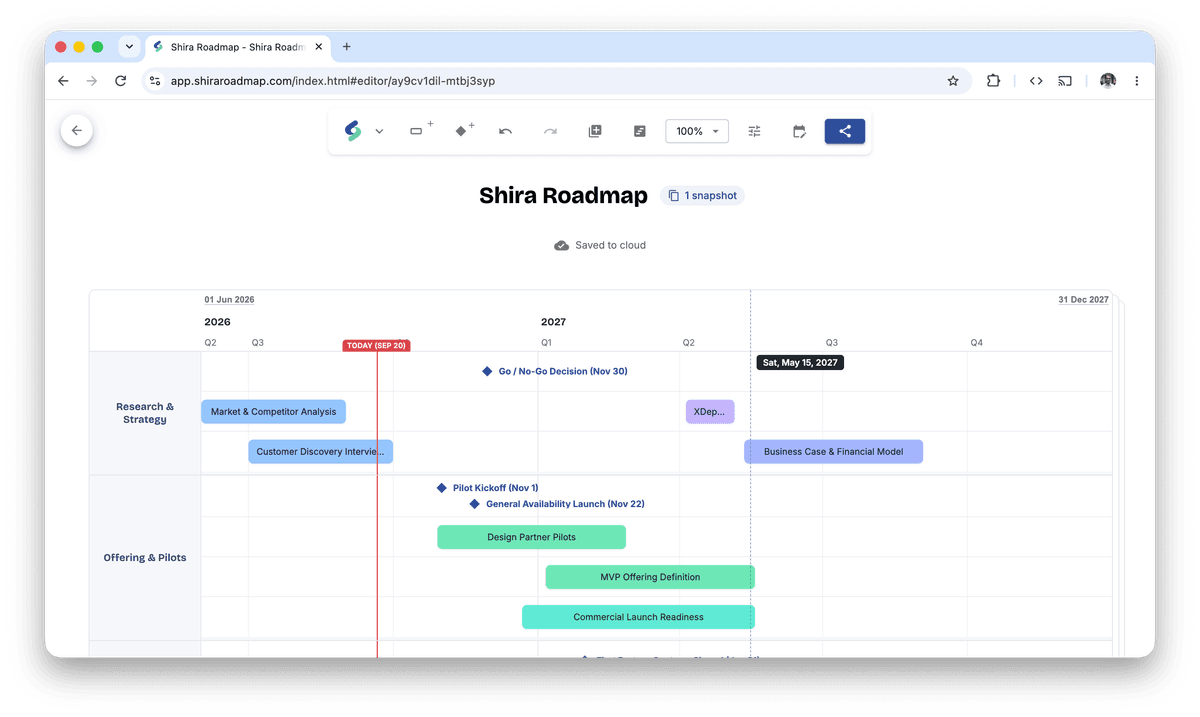
A roadmap usually doesn’t show task dependencies explicitly. That’s not a limitation — it’s the format doing its job. The moment a roadmap starts showing dependency arrows and day-level precision, it’s stopped being a roadmap and started becoming a Gantt chart, usually without anyone deciding that on purpose.
Gantt Chart
A Gantt chart is a detailed, task-level bar chart with exact start and end dates for individual tasks, dependency arrows connecting tasks that rely on each other, and often resource assignment or percent-complete tracking. It’s built for the people actually executing the work, not for a leadership audience skimming for direction.
The format originated in construction and manufacturing, where dependencies are physical realities — you genuinely cannot pour a foundation before you’ve dug it. Applying that same visual precision to a strategic plan, where a Q3 launch date is a target rather than a physical constraint, borrows a false sense of certainty from an entirely different kind of work.
Project Plan
A project plan is the broader document a Gantt chart is usually just one piece of. It includes scope, objectives, budget, resource allocation, a risk register, stakeholders, and success criteria. The timeline — whether that’s a Gantt chart or a simpler roadmap — is the visual component, not the whole plan.
Asking “is this a project plan or a roadmap” is really asking “am I looking at the whole picture, or just the timeline piece of it.” They’re not competing formats — one is usually a section of the other.
Where the Confusion Actually Comes From
Almost nobody sets out to build a roadmap that’s actually a disguised Gantt chart. It happens because people reach for whichever tool is already open — usually PowerPoint or Excel — and use it to answer all three questions in one file: strategic direction, task-level timing, and resourcing. A single slide ends up trying to serve a board audience and an execution audience at once, and does a mediocre job for both, because the underlying formats were never meant to be the same thing.
Which One Do You Actually Need?
- Presenting direction and priorities to people outside the day-to-day work: you need a roadmap.
- Coordinating task-level execution with real dependencies inside a team: you need a Gantt chart.
- Documenting scope, budget, risk, and resourcing for a specific initiative: you need a project plan, with a timeline embedded inside it.
- Most people who ask this question, especially if they’re not running day-to-day execution, only actually need the first one.
FAQ
Can a roadmap have dependencies like a Gantt chart?
Technically, but it usually defeats the purpose. If dependency tracking is genuinely necessary, that’s a sign the underlying need is a Gantt chart or a project-management tool, not a roadmap trying to do double duty.
Is a product roadmap the same thing as a project roadmap?
The terminology shifts by field, but the underlying distinction holds: it’s still a high-level, direction-focused view built for an audience that doesn’t need task-level detail, whether the thing being planned is a product, a campaign, or an initiative.
Do I need all three — a roadmap, a Gantt chart, and a project plan?
Only if you’re running the full lifecycle of a complex initiative yourself. Most people preparing something for a board, a client, or a stakeholder audience only need the roadmap.
What tool should I use for each one?
A roadmap tool built for communication rather than execution tracking for the roadmap itself; a dedicated Gantt or project-management tool for detailed task scheduling; and the project plan is usually a document with the relevant timeline embedded inside it, not a single all-in-one visual.