
Short answer: if you build a roadmap a few times a year rather than manage one continuously, PowerPoint is the tool you already have but fights you every time the plan changes; Jira and Aha! are built for continuous product management and are genuinely strong at it, but bring more structure — and more cost — than an occasional roadmap needs; Shira sits in between, built specifically for people who need a polished, presentable roadmap without adopting a product-management workflow.
Here’s the detailed breakdown, tool by tool.
At a glance
| Best for | Roadmap-specific pricing | Learning curve | Exports to PowerPoint | |
|---|---|---|---|---|
| PowerPoint | One-off, fully custom slides | Already owned | None — everyone knows it | N/A, it is PowerPoint |
| Jira | Engineering teams already living in Jira | Basic Timeline: free. Advanced Roadmaps: requires Jira Premium (~$14.50/user/mo). Jira Product Discovery: free up to 5 creators, paid beyond that | Steep — roadmaps are built from your ticket data | Not natively |
| Aha! Roadmaps | Product orgs running a full strategy-to-delivery process | Roadmaps hub starts at $59/user/month, billed annually | Moderate to steep — a full suite with its own workflows | Not natively |
| Shira | Anyone who builds a roadmap occasionally, not as a full-time job | Free to start, no credit card | Minutes — drag-and-drop, no data model to learn | Yes, native editable shapes (beta) |
PowerPoint
What it’s actually good at: everyone already has it, there’s zero setup, and you have complete visual freedom — no template constraints, no data model to learn first.
Where it breaks down, specifically for roadmaps: a PowerPoint roadmap isn’t really a roadmap, it’s a drawing that looks like one. There’s no underlying structure — no real dates, no real dependencies — so every change means manually realigning boxes by eye. Add one activity and the whole layout can need rebuilding. There’s no built-in way to compare “what the plan looked like last month” against today without keeping multiple files around, usually with increasingly desperate names. And once it’s shared, it’s frozen — a stale copy that quietly diverges from reality the moment the real plan changes.
Honest verdict: fine for a single, one-time visual that will never be touched again. A poor fit for anything you’ll need to update, which is most roadmaps.
Jira (roadmaps specifically, not the whole platform)
Jira’s roadmap capability isn’t one thing — it’s split across three tiers, and which one you get depends entirely on your plan.
Basic Timeline ships free with every Jira plan. It’s a lightweight, per-project Gantt-style view built from your epics (and, as of 2026, stories, tasks, and subtasks too). It’s explicitly not meant to replace a dedicated planning tool — Atlassian’s own community documentation describes it as intentionally limited.
Advanced Roadmaps (also called Jira Plans) unlocks cross-project planning, dependency tracking, and capacity management — but only on Jira Premium, currently around $14.50/user/month.
Jira Product Discovery is a separate product entirely, aimed at product managers doing idea prioritization and roadmapping distinct from engineering execution. It’s free for up to five “creators,” with paid tiers beyond that.
Where it breaks down, specifically for the occasional roadmap-builder: a Jira roadmap is a view generated from your ticket data, not a document you directly design. If your team’s sprints run long or get rescoped mid-cycle — which is normal — your roadmap shifts unpredictably underneath you, and a stakeholder who checks it twice in the same week can see two different timelines. Atlassian’s own more detailed guidance on this explicitly recommends switching to quarter-level buckets for anything stakeholder-facing, specifically to hide that instability. And if you’re not already living in Jira for engineering work, there’s real setup cost just to get a project structured well enough to produce a roadmap from.
Honest verdict: genuinely strong if you’re already running engineering delivery through Jira and want the roadmap to reflect real ticket data. A heavy, indirect way to produce a roadmap if that’s the only thing you need.
Aha! Roadmaps
Aha! is one of the most established platforms in this space, and it shows — strategy, goals, idea management, and roadmapping are all genuinely integrated, with an increasingly capable built-in AI assistant layered across the suite.
Where it breaks down, specifically for the occasional roadmap-builder: Aha! is priced and built for teams running a continuous, dedicated product management process — the Roadmaps hub alone starts at $59 per user per month billed annually, and the fuller suite (Ideas, Develop, Knowledge, Whiteboards) is sold as additional hubs on top of that. That’s a real, ongoing cost and a real onboarding investment for something you might touch four or five times a year. It’s built to be a system of record you live in daily, not a tool you open, use for twenty minutes, and close.
Honest verdict: an excellent choice for a dedicated product team running strategy end-to-end. Expensive and more tool than necessary if a roadmap is an occasional deliverable rather than a daily workspace.
Shira
Shira is built around a narrower, more specific bet: most people who need a roadmap aren’t product managers, and don’t want to become one just to produce a plan for a board meeting or a client update.
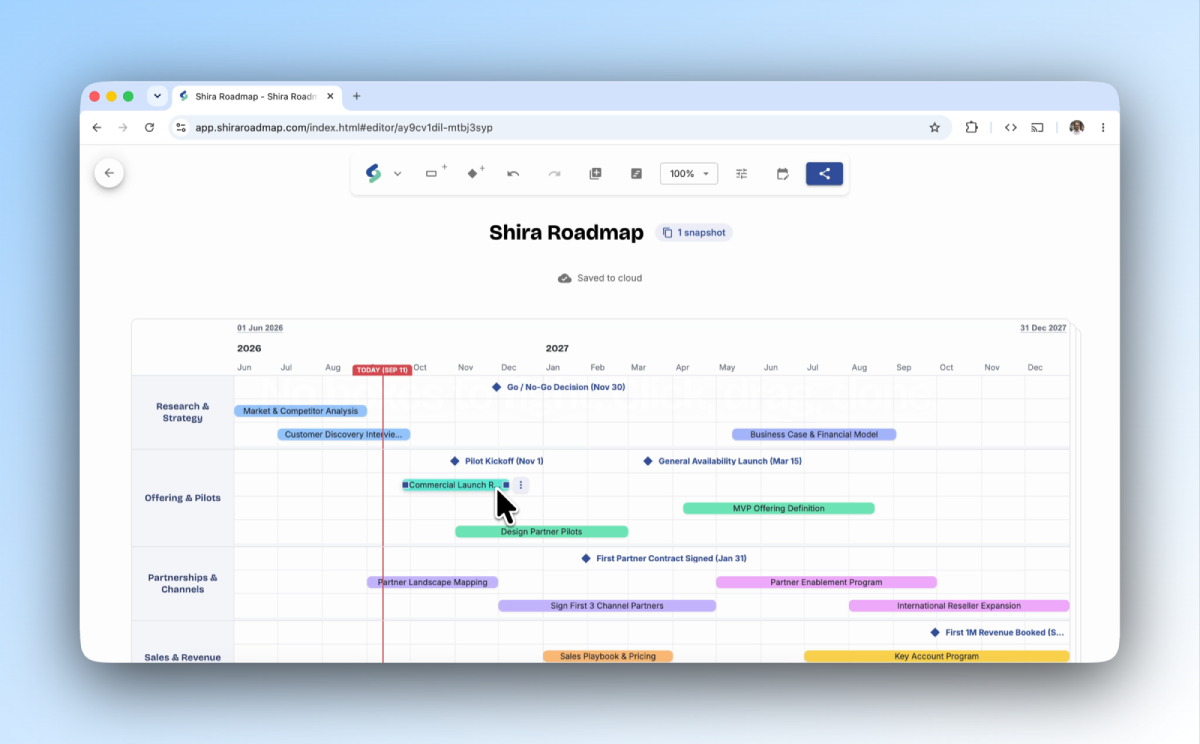
What it does: a direct-manipulation canvas — click to add an activity, drag to move it, no forms or dialogs required. One roadmap reads at any timescale, from a six-week sprint view to a three-year strategy, without rebuilding it. Named snapshots (up to 10 per roadmap) let you checkpoint a plan before a replan and compare exactly what changed, was added, or was removed since — with automatic version history behind every save as a second safety net. Export lands as a real, editable PowerPoint file (currently in beta) rather than a flattened image, or share a live, read-only link that always reflects the current version instead of a stale attachment.
Where it’s a poor fit: Shira doesn’t try to be a product management suite. There’s no ticket-level engineering integration, no backlog, no sprint planning — if that’s what you actually need, Jira or Aha! are the right tools, not this one.
Honest verdict: built specifically for someone who needs a credible, presentable roadmap a few times a year, without adopting an entire workflow to get it.
Which one should you actually use?
- You need one slide, once, and will never touch it again: PowerPoint is genuinely fine.
- You’re already running engineering delivery through Jira and want the roadmap tied to real ticket data: Jira, likely with Advanced Roadmaps if you need cross-project views.
- You run product strategy as a full-time, continuous process across a team: Aha! is built for exactly that.
- You build a roadmap every few weeks or every quarter — not as your job, but as one part of it — and mostly need it to look right and stay current: that’s the gap Shira is built for.
FAQ
Is Jira good for building a roadmap if you’re not an engineering team?
Not particularly. Jira’s roadmap views are generated from ticket data, so getting a usable roadmap out of it means first structuring a project inside Jira’s data model — real overhead if engineering delivery isn’t already running through it.
Is Aha! worth it for a small team?
Usually not on cost alone. Aha! Roadmaps starts at $59 per user per month billed annually, which is built to be justified by daily use across a dedicated product team — expensive for a roadmap that gets touched occasionally.
Why does my PowerPoint roadmap keep breaking every time I update it?
Because it isn’t a structured document — it’s a drawing. There’s no real underlying data, so every change has to be manually realigned, and there’s no way to compare an earlier version against the current one without keeping separate files.
Can I export a Shira roadmap to PowerPoint if I need to hand it off?
Yes — export produces a real, editable PowerPoint file with native shapes, not a flattened image, so anyone can keep editing it afterward. This feature is currently in beta.
What’s the actual difference between a roadmap tool and a project management tool?
A roadmap tool’s job is to communicate a plan clearly to people who aren’t managing the day-to-day work. A project management tool’s job is to run that day-to-day work. Jira and Aha! do both, bundled together; Shira deliberately does only the first.